
Drywall Texture Matching: Why Patches Show, and How to Make Them Disappear
Showcase Drywall · Eagle, Colorado · 26 years in the valley
A drywall patch fails for one of two reasons, and both are about the finish rather than the structure. Either the texture does not match the wall around it, or the paint does. Of those two, texture matching is the harder skill and the one that decides whether you can find the patch from across the room.
This article explains how texture matching is actually done, which textures are easy and which are not, and what to look for in a drywall repair quote so you do not pay twice.
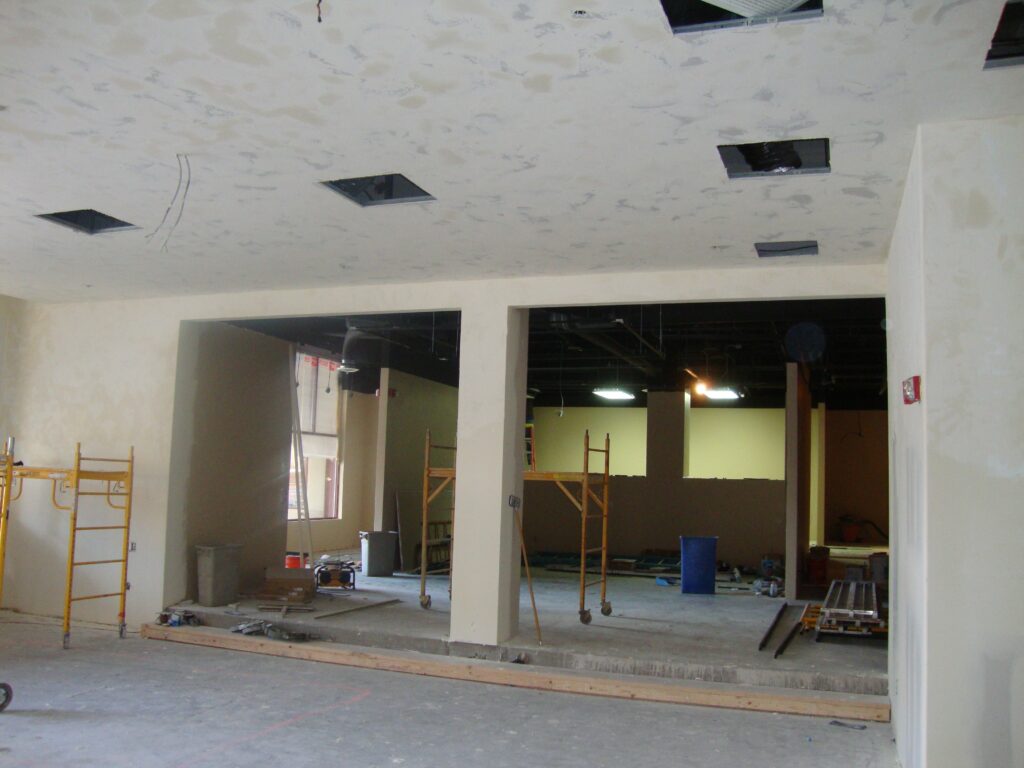
Why a patch shows even when the repair is sound
Picture a four inch hole in a living room wall, patched properly: backing in, new drywall cut to fit, compound applied, sanded flat. Structurally the work is sound. Visually it has two problems, and the finish is where both of them live.
The first is texture. The drywall around the opening is not flat. It carries a pattern, applied years ago with a sponge, a brush, a roller, a trowel or a spray gun. The new work is dead smooth, and smooth next to texture reads as a hole in the pattern, even when the colour is identical.
The second is paint. New compound is more porous than the painted drywall beside it, so the same coating dries to a different sheen over each. That is called flashing.
Texture matching solves the first. Painting the full surface solves the second. A repair that skips either one is the one you can see.
The textures found in valley homes
Different textures need different tools and different amounts of practice. These are the ones we meet most often in homes around here.
Orange peel
A fine spattered pattern, sprayed on with a hopper gun and left alone. It looks like the skin of an orange. Orange peel is the most forgiving texture to match on a repair, because the pattern is small and regular. Getting the air pressure and the compound thinned correctly is most of the work.
Knockdown
Orange peel sprayed heavier, left to set for a few minutes, then flattened with a wide blade so the high points spread into small plateaus. The difficulty is timing. Knock it down too early and the pattern smears; too late and it does not flatten at all. Every surface has its own window, affected by temperature and how dry the air is, which in this climate is very dry.
Hand textures: skip trowel and Santa Fe
Mud applied and then worked with a trowel, leaving broad irregular marks with high and low areas clearly visible. These are the textures that separate finishers from the rest. There is no tool setting to copy, only the hand of whoever applied it, which means matching one is a matter of reading the original pattern and reproducing the same motion, the same compound consistency and the same pressure.
Heavy hand textures were popular in valley homes 20 years ago, so they turn up constantly in repair work.
Stomp and slap brush
Mud applied, then hit with a stiff brush on a pole to lift it into peaks, sometimes knocked down afterwards. The brush pattern is distinctive and the match depends on using the same kind of brush, loaded the same way.
Sponge and roller textures
Mud thinned and applied with a heavy nap roller, the roller loaded lightly, or dabbed with a sponge. Common in older bathrooms and hallways. A sponge texture is easy to approximate and surprisingly hard to match exactly, because the sponge’s own pattern is part of the result.
Smooth
No texture at all, which sounds simplest and is not. On smooth drywall there is nowhere to hide a repair: the new work has to be feathered out wide and the whole surface has to take paint evenly. Smooth walls in daylight are where a skim coat across the full surface earns its cost.
How texture matching is actually done
Read the existing pattern
Before anything else, the finisher looks at the existing texture closely, from several angles, in the light the room actually has. The questions are what tool made it, how heavy the application was, whether it was knocked down, and how worn it is. Twenty years of cleaning and repainting softens a pattern, so matching new work means matching the drywall as it is now, not as it left the hopper.
Mix to the right consistency
Texture mud is thinned with water, and the ratio changes the result completely. Too thick and a sprayed pattern comes out coarse and heavy; too thin and it runs and flattens. Getting this right is trial and error against the actual drywall.
Test off the wall first
This is the step that separates a match from a guess. The texture goes onto a test board or a piece of scrap drywall, not onto your ceiling or your walls. If the pattern is wrong, the board gets scraped and the mix adjusted. A finisher who sprays straight onto the repair area is testing on your house.
Blend outward, do not stop at the edge
Texture taken exactly to the boundary of a patch leaves a visible rectangle, because the pattern inside it is new and the pattern outside is 20 years old. The texture has to be feathered out beyond the repair so the transition falls in the middle of the pattern rather than at a line.
Match the sheen, not just the colour
Then the painting. A patched area takes paint differently from the wall around it, so painting the repair area alone produces a different kind of visible defect. The full surface gets painted, corner to corner. On a ceiling, that usually means the whole ceiling, because a ceiling is one uninterrupted plane and the eye follows it.
Which textures are hard to match, and what to do instead
| Texture | Difficulty on a repair | Realistic outcome |
|---|---|---|
| Orange peel | Straightforward | An invisible repair |
| Knockdown | Moderate, timing-dependent | An invisible repair when the timing is right |
| Stomp or slap brush | Moderate | Very close, usually invisible once painted |
| Sponge or roller | Moderate | Close; worth testing more than once |
| Skip trowel or other hand texture | Hard | Very close in skilled hands; occasionally the honest answer is to refinish the wall |
| Smooth | Deceptively hard | Invisible with a wide feather and full-wall paint |
When a hand texture cannot be matched convincingly in a small area, there are two honest options. Retexture the whole surface, so the pattern is consistent even if it differs slightly from the next room. Or skim it smooth and leave the texture behind entirely, which is what a lot of owners choose once they see a smooth wall next to a dated one.
What nobody should do is accept a close-enough match in the middle of a surface facing a window. In these homes, that is the one spot where it will show every afternoon.
What texture matching services cost, and why
Texture matching services are labour, not materials. The compound for a patch costs a few dollars. What you are paying for is a finisher who can read a pattern and reproduce it, plus the testing, plus the extra blending area, plus the paint finish across the full surface.
In practice, matching is most of the difference between a handyman patch at a few hundred dollars and a repair that costs more and cannot be found afterwards. That cost difference buys the finish, not the filler. The cheaper job is not doing less of the same work. It is skipping the testing, the blending and the paint scope.
The cost also depends on where the work is, and construction access plays into it too. A small repair in a smooth, low-light hallway is quick. The same work on a ceiling, or on a wall opposite a two-storey window, takes a different level of care, and the cost follows the care rather than the square footage.
Texture on a new drywall installation versus texture on a repair
It is worth knowing why texture is easy on a new installation and hard on a repair, because it explains the price difference.
On a new drywall installation during construction, the whole room gets textured at once. The finisher sets the gun, sprays the entire room in one pass, and every surface carries the identical pattern because it was applied in the same minutes from the same mix. There is nothing to match. Construction sites are also empty shells, so overspray does not matter and nothing needs protecting.
A repair during normal construction reverses all of that. The existing pattern was applied by someone else, years ago, with a different mix, possibly a different tool, and has since been painted two or three times. The new texture has to meet the existing texture in the middle of a surface, with furniture in the room and a floor that cannot be sprayed.
That is why a texture quote on a new drywall installation is priced by the square foot and a repair is priced by the opening. On an installation you are buying coverage. On a repair you are buying a match, and the cost reflects that.
The same logic applies if you are building an addition. Where new construction meets an existing room, the texture on the new drywall has to match what is already there, and the cost of getting that wrong is visible forever, and the join between old and new is exactly where it will show if nobody plans for it.
Trying it yourself: what is worth a try
Plenty of small jobs are worth a try before you call anyone, and some are not.
Worth a try: a small opening in a smooth, painted surface in a room without much direct light. A patch kit, a putty knife, a little sanding and a coat across the whole wall will usually get you a result you are happy with.
Also worth a try: an orange peel repair in a hallway or a closet, using an aerosol texture can. Shake it properly, try it on cardboard first to set the spray pattern, hold it well back, and build the texture up in thin passes rather than one heavy one.
Not worth a try: knockdown, any hand texture, anything on a ceiling, anything on a surface facing a window, and anything where water was involved. A roller or a sponge can get you close on a flat texture, and a roller never reproduces a trowelled pattern. A roller is for flat patterns only, and a failed attempt costs more to fix than the original hole did, because the old mud has to come off before proper work starts.
If you do try it and the result is not right, do not keep adding mud. Scrape it back to flat and leave it for whoever comes next. A flat surface is an easy starting point. A lumpy one is not.
Our texture matching services
Texture matching is part of every job we quote, not a separate service with its own line item. The same crew that cuts out the damage, hangs the new drywall and finishes it also matches the texture and paints the surface, which means nobody can blame the trade before them for a poor match.
Those services cover orange peel, knockdown, stomp and brush patterns, sponge and roller work, skip trowel and other hand textures, plus interior plaster and Venetian plaster where a job calls for it. If a texture genuinely cannot be matched in place, we will tell you what refinishing the surface would cost instead of guessing at a patch and hoping.
Questions about drywall texture matching
Can any drywall texture be matched?
Nearly all of them, by someone who does it regularly. The constraint is rarely the pattern itself; it is whether the area is large enough to blend into and whether the drywall is in a location where a very slight difference would be visible.
How long does a textured patch take?
Two or three days for most jobs, because the compound has to dry, the texture goes on after that, and the paint finish goes on after the texture. Each stage waits on the one before it. Work finished the same day has skipped something.
Can I match the texture myself?
Sometimes. Aerosol texture cans from the hardware store do a passable orange peel on a small patch in a low-light room, and for a wall behind a door that may be all you need. They do not reproduce knockdown or hand textures well, and the usual outcome on a visible surface is work more obvious than the hole was.
What if the repair area has already been patched badly?
Then the first thing to get done is removing the previous work. Matching over the top of someone else’s mismatched work means matching two different patterns at once, which cannot be done. The compound comes off, the surface goes back to flat, and the texture starts from a known state.
Why does my patch look right until the paint dries?
Because you are seeing flashing rather than a texture problem. Wet paint hides the difference in porosity between new compound and old painted drywall; dry paint reveals it. Painting the full surface, with a primer on the repaired area first, is the fix.
Do I need to repaint the whole room?
The whole surface, usually. The whole room, only when the walls meet without a break or when the paint is old enough that the existing colour has shifted. On a ceiling, plan on the whole ceiling.
Does the dry air here affect the texture?
Yes, more than most people expect. Compound sets faster in dry air at altitude, which shortens the window for knockdown work and makes the mix consistency more sensitive. It is one reason a crew that works in these homes every week gets closer matches than one that does not.
Getting a repair that cannot be found
Four things get a drywall repair to invisible: the right backing so the work is solid, a flat and well-feathered finish, a texture matched by testing rather than guessing, and paint across the full surface. Miss any one of them and it shows.
When you get a repair quote, ask two questions. Will the texture be tested on a board before it goes on the wall? And how much of the surface gets painted? The answers tell you most of what you need to know about which kind of repair you are buying.
Showcase Drywall has been matching textures and repairing drywall in Vail, Beaver Creek, Avon, Edwards, Eagle and Gypsum for 26 years, in homes where the walls get looked at in hard mountain light. Call (970) 977-0247 for a free quote and we will tell you honestly whether your texture can be matched in place or whether the surface is better refinished.