
Drywall Ceiling Repair After a Leak: Patch or Replace?
Showcase Drywall · Eagle, Colorado · 26 years in the valley
If a leak has stained or sagged a drywall ceiling, the decision is between repairing it in place and replacing the damaged section. The rule we use is simple: if the drywall is still flat, firm and dry, repairing in place is the right fix and costs a fraction of the alternative. If the drywall is sagging, soft, crumbling or still wet, that section comes out.
Getting this decision right matters more on a ceiling than anywhere else in a house, because a drywall ceiling carries its own weight against gravity and because it is the surface everyone looks at under daylight.
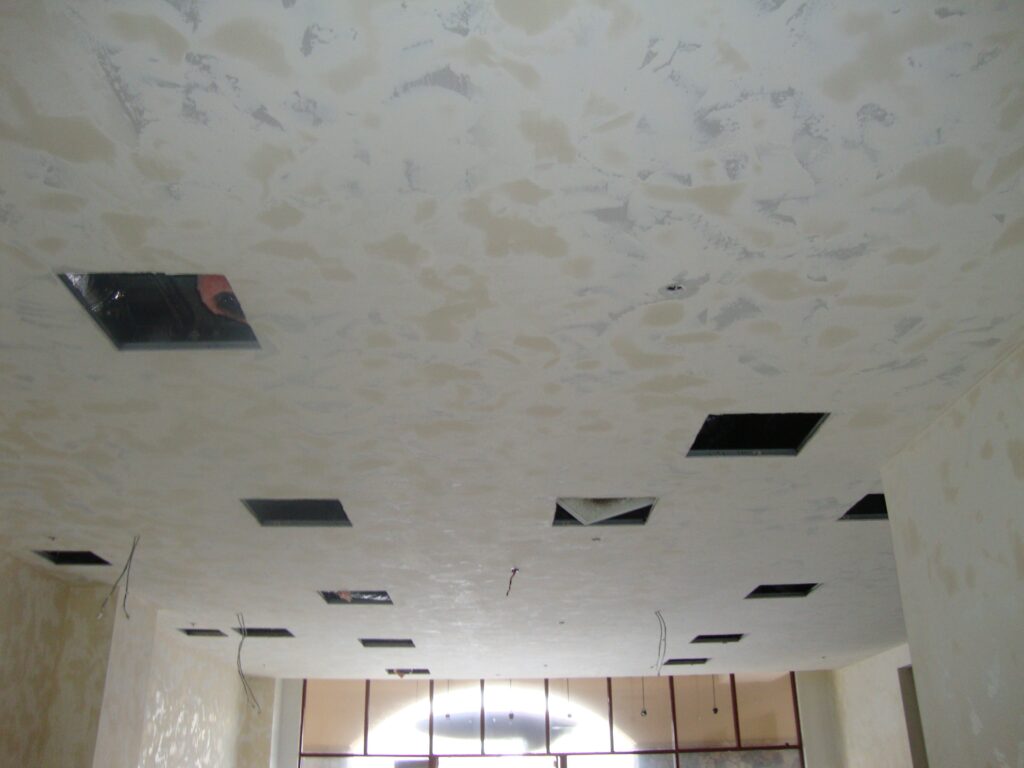
First, stop the water
No drywall ceiling repair starts until the leak is fixed and the source is confirmed. This sounds obvious and is the most common mistake we are called in behind.
A drywall ceiling repair done under a leak nobody has fixed will fail, usually within weeks. The replacement material gets wet, the tape releases, the fresh paint stains, and you pay twice. Whoever has to fix it, whether the source is a plumbing fitting, a heating line, a roof, an ice dam or a bathroom above, the plumber or the roofer comes first to fix the source.
Once the water is stopped, you have time. A dry stained ceiling is not an emergency and nothing gets better by rushing the fix before the structure above has dried out.
Patch or replace: how to tell
Test the damaged area before deciding anything.
Press it. Firm, sound drywall that does not give under a hand is fine. If it feels soft or your fingers sink into it, the gypsum core has broken down and no amount of compound will restore it.
Look along it. Sight across the ceiling from a doorway. A sag of even half an inch across a few feet is visible and means the drywall has lost strength or the fasteners have pulled.
Check the staining pattern. A small round stain from a one-off drip is usually surface-level. A large irregular stain with a dark edge, or several overlapping stains, means repeated or prolonged water damage.
Check the moisture. A meter is better than a guess. Wet drywall and damaged insulation can look dry from below for a long time, particularly in a vented attic where the top side stays cold.
| Condition | Repair |
|---|---|
| Small stain, firm board, dry | Seal the stain, repaint the ceiling |
| Larger stain, firm board, dry, no sag | Repair in place, then repaint the full ceiling |
| Soft or crumbling drywall | Cut out and replace that section |
| Any visible sag | Cut out and replace that section |
| Still damp, or insulation above is wet | Open it up, remove wet material, dry, then replace |
| Mold visible on the drywall or the framing | Remove the affected material, address the cause, then rebuild |
Why the insulation above matters as much as the board
This is the part that gets skipped and the reason a cheap ceiling repair turns into a bigger job.
Batt insulation above a ceiling holds water like a sponge. When a leak soaks it, the drywall below shows it but the insulation is the reservoir. Close a ceiling up with wet insulation still sitting on it and the moisture has nowhere to go but back into the new material. That is how you get mold in a cavity nobody opens for two years.
So any repair where water reached the cavity follows the same sequence: open it up, pull out the wet insulation, let the space dry, then close it with new material. Checking the framing while it is open costs nothing and tells you whether the damage goes further.
How the replacement is done
- 1. Open and inspect. The wet drywall is cut back to sound material, usually to the framing members either side so the replacement board has something to fasten to.
- 2. Remove wet material. Insulation out, cavity checked, framing looked at.
- 3. Dry the space. Air movement for as long as it takes. On most jobs this is a day or two, and it cannot be rushed with compound.
- 4. Hang the board. Drywall cut to fit, fastened to the framing, replacing the damaged section. On ceilings we hang 5/8 inch board, which sags less over a span than thinner material, at a materials cost difference of a few dollars a sheet.
- 5. Tape and finish. Paper or mesh tape at every new joint, bedded in compound, with a second tape pass where two new sheets meet, then coats of compound feathered well past the damaged area.
- 6. Match the texture. The texture on the surrounding ceiling is read, mixed and tested on a board before anything goes overhead.
- 7. Prime and paint the whole ceiling. Not the patch. A ceiling is one plane and spot painting shows.
That last step is where most of the argument about ceiling repair cost comes from, and it is not negotiable if you want the repair to be invisible.
Why ceiling repairs cost more than wall repairs
Several things stack up:
- Gravity. Every coat of compound is applied overhead, which is slower and more physical than working on a wall.
- Staging. Anything above a normal reach needs a platform rather than a ladder, so the finisher can work square to the surface.
- Texture. Most ceilings in these homes carry a sprayed texture, matched from below.
- Paint scope. The full plane gets painted, every time.
- Drying time. A wet cavity adds days before any repair work begins.
In this valley, a drywall ceiling repair where a section is cut out, insulation replaced, new board hung, finished, textured and the ceiling repainted typically runs $2,000 to $3,000 and takes about four days. A small stain on a sound ceiling, sealed and repainted, is a fraction of that.
The cost that catches people out is the second repair: a patch done over wet material, discovered a year later, now with mold remediation attached to it.
Sagging ceilings without a leak
Not every sag is water. Three other causes turn up:
The wrong board on a wide span. Half inch drywall on ceiling framing at 24 inch centres sags over time, especially under a sprayed texture that adds weight. The fix is replacement with 5/8 inch drywall.
Fastener failure. Screws driven too deep tear the paper face and lose their grip. The drywall drops a fraction at each fastener and the surface dimples or sags between them.
Too much texture or too many coats of paint. Repeated repainting of a heavily textured ceiling adds real weight, and a ceiling already at its limit can start to droop.
All three need replacement or refastening, because the drywall itself is the problem.
Ceiling repair during a remodeling job
If you have remodeling work planned, that remodeling work is the moment to get a ceiling dealt with, because remodeling absorbs most of the setup cost.
During remodeling the room is already protected, the crew is already on site, and the ceiling can be handled as part of the remodeling rather than as a separate visit with its own setup cost. The same is true if you are having a bathroom redone above the stained ceiling: the remodeling has the plumber already opening things up, so the drywall below gets repaired once, after the plumbing is finished, rather than twice.
Remodeling is also when ceiling specification decisions get made, and when the cost of changing them is lowest. If the old ceiling carried a heavy texture nobody likes, remodeling is the cheapest opportunity to skim it smooth, at a fraction of the cost of doing it alone, because the protection and the staging are already in place. Doing that as a standalone project later costs more for the same result.
One scheduling note that saves real money on any remodeling job: get the ceiling repair into the schedule after the trades above are finished and before the painters arrive. Ceiling work after the painting means paying the painters to come back, which is a cost nobody budgets for.
What a drywall ceiling repair costs here
Ceiling repair cost comes down to how much has to come out and how much of the plane gets painted. These are the ranges this work runs in Eagle County:
| Job | What it covers | Cost |
|---|---|---|
| Stain sealed and ceiling repainted | Sound dry drywall, stain-blocking primer, full plane repainted, no cut-out | $600 to $1,200 |
| Repair in place | A small area cut out, new drywall in, finished, texture matched, ceiling repainted | $1,200 to $2,000 |
| Section replaced after a leak | Wet drywall and wet insulation out, cavity dried, new drywall, finished, textured, repainted | $2,000 to $3,000 |
| Whole ceiling replaced | Full plane out, insulation replaced, new drywall hung, finished, textured, painted | From $4,000, depending on the room |
Three things move the cost inside those ranges, and none of them is the drywall itself. The size of the damaged area is the obvious cost driver. Access is the second cost: a flat eight foot ceiling is quicker than a vaulted one needing staging. The third is the texture, since matching a heavy sprayed pattern takes longer than a light one.
What the cost does not change much with is materials. Drywall and compound are inexpensive. Nearly all of the cost of these repairs is labour, drying time and paint, and the cost of a second visit if the first attempt was done over wet material.
Drywall ceiling services and what each one includes
Our drywall ceiling services run from a single stain to a full replacement, and these services all cover the same steps: protection, removal of wet material, drywall, tape and finish, a matched texture, paint across the plane, and daily cleanup. These services are quoted as one job rather than as a repair plus extras, because a ceiling repair without the paint included is not finished work, and quoting those services separately invites a surprise.
If a ceiling needs drying before it can be closed, that is in the schedule we give you rather than a surprise later. If the wet area turns out to be larger than what we quoted once it is open, we stop and show you before carrying on.
Insurance
Repair of water damage from a sudden leak, such as a failed fitting or a burst line, is often covered by a homeowners policy. Damage from long-term seepage or deferred maintenance usually is not covered. Your insurer decides, not your contractor.
What helps a claim is a record of the damage: photographs of the damage before anything is cut, a written scope of what was removed and replaced, and an invoice that matches the scope. We write the scope down as a matter of course, so you have it if you need it.
Common questions about drywall ceiling repair
Can I just paint over a water stain?
Sometimes, if the drywall is dry and firm and the stain is small. Use a stain-blocking primer first, because water damage bleeds through ordinary paint. If the stain reappears, the leak was never fixed.
How do I know if the drywall is still wet?
Press the drywall, look for sagging, and use a moisture meter if you have access to one. A ceiling can feel dry on the painted side while the insulation above it is still saturated.
Will the repair be visible afterwards?
It should not be. An invisible ceiling repair depends on three things: a well-feathered drywall finish, a matched texture, and paint across the whole plane. Skipping the third is the usual reason a finished repair still shows.
How long before I can use the room?
Most drywall repairs are quiet work with drying time between stages. The room is usable in the evenings on most jobs, with the area tented off. Expect four days of access to get a cut-out and replacement done, longer if the cavity needs drying.
Can you repair a ceiling without replacing the insulation?
Only if the insulation is dry. If it got wet, it comes out and the cost of replacing it is small. Compressed, soaked insulation has lost its thermal value anyway, so leaving it in place costs you twice.
Is a popcorn or textured ceiling a problem to repair?
Texture on a drywall ceiling is matchable. The thing to check on an older textured ceiling is whether it predates the 1980s, in which case the texture may contain asbestos and needs testing before anyone disturbs it. That is a straightforward test, and it is worth doing before work starts.
Do you work in occupied homes?
Yes, most of this work is in finished homes. The area gets tented off, floors and furniture get covered, and the site is cleaned at the end of each day.
Getting the ceiling sorted
The decision is not complicated. Dry and firm means an in-place repair. Soft, sagging or wet means cutting the damaged drywall out. What turns a simple job into an expensive one is closing up drywall over material that is still holding water.
Showcase Drywall repairs drywall ceilings in Vail, Beaver Creek, Avon, Edwards, Eagle and Gypsum, and has been doing drywall work in this valley for 26 years. We will tell you which of the two repairs your ceiling needs and why, and what it will cost. Call (970) 977-0247 for a free quote, back to you within 24 hours.