
Drywall Repair Cost in the Vail Valley: What Homeowners Actually Pay
Showcase Drywall · Eagle, Colorado · 26 years in the valley
Most homeowners here want one number before they call anyone, so here it is: a straightforward drywall repair in a Vail Valley home runs a few hundred dollars for a single small hole, roughly $1,500 to $2,500 for a multi-room drywall patch job, and $2,000 to $3,000 for a drywall ceiling with water damage done properly. A full room or stairwell refinish is a different kind of project and runs from $15,000 up.
Those are costs for finished drywall work in mountain homes: cut out, replaced, finished, texture matched and painted, with the room left clean. The reason two quotes for the same hole can differ by a factor of four is almost never the materials. It is what each quote includes. This article sets out what the work involves at each price, so you can tell a complete quote from an unfinished one.
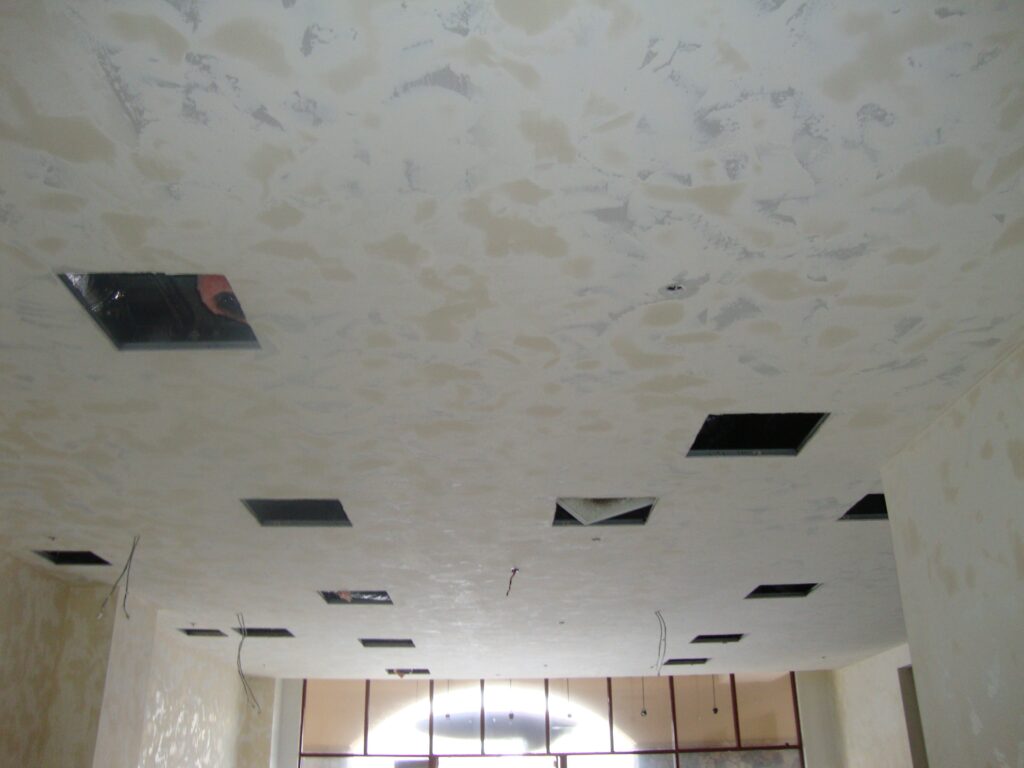
What drywall repair costs in Eagle County
Below is what homeowners in Eagle County can expect to pay for completed drywall repair work. These are costs for the whole job: the damage cut out, new material in, finished, texture matched, painted, and the home cleaned.
| Project | Typical scope | Typical local cost | Typical duration |
|---|---|---|---|
| Single small drywall hole repair | One opening, patch, texture, paint that wall | $400 to $800 | 1 to 2 days |
| Multi-room drywall patch | Openings in three or four rooms after electrical or plumbing work, all finished and painted | $1,500 to $2,500 | 3 days |
| Drywall ceiling, water damage | Cut out a damaged section, replace insulation, new drywall, finish, texture, repaint overhead | $2,000 to $3,000 | 4 days |
| Drywall crack repair, several rooms | Cut out, re-tape, finish, texture, paint | $1,200 to $2,500 | 2 to 4 days |
| Garage drywall repair | Replace damaged lower sections, finish, paint | $1,500 to $3,500 | 3 to 5 days |
| Stairwell and hallway refinish | Strip heavy texture, skim coat to a smooth Level 5 finish, repaint | $15,000 to $25,000 | 10 days |
| Specialty plaster feature | Hand-troweled Venetian plaster around a fireplace, blended into the walls | $15,000 to $20,000 | 3 to 4 weeks |
A multi-room patch at $1,800 and a leak-damaged ceiling at $2,400 are ordinary numbers for this work in this valley. So is a ten day stairwell refinish at $20,000 in a large home. If you have been quoted $400 for a leak-damaged ceiling, that is not a bargain. It is a quote for a different and worse job, and you will meet the difference again the first afternoon the light hits that ceiling.
Where the money actually goes
Days, not hours
Drywall repair is priced in days because mud dries on its own schedule. A repair is cut out and hung on day one, coated and left, sanded and recoated on day two, then textured, primed and painted. Nobody can compress that into an afternoon, and a quote that implies otherwise is quoting a different job: filler, one coat, spot paint, done.
The drive is part of the job
A crew working in Vail Village or Bachelor Gulch spends real time getting there, parking, and carrying materials in. In winter that time grows. A fair quote shows that as part of the cost rather than hiding it in a square foot figure.
Mountain homes show everything
This is the one most homeowners only discover afterwards. Tall windows and high ceilings mean light crosses a wall at a shallow angle, and that light finds every flaw. The industry term is critical lighting, and it is why a finish that would pass in a suburban hallway fails in a Vail great room.
The practical effect on cost is that more of these drywall repairs need a higher finish level, and a higher finish level means another full skim coat of the surface. The materials barely change. The labor does.
The painting is not optional
New drywall mud is more porous than the painted drywall around it, so paint sits differently on a patch. The result is called flashing, and it is the dull or shiny rectangle you see on a wall when the light is right. The only reliable fix is painting the whole wall or the whole area overhead instead of the patch. That is real labor and real materials, and any quote that leaves it out is incomplete.
Texture matching is skilled work
Many valley homes with original drywall from 20 years ago carry heavy hand textures. Matching one is not a product you buy. It is a finisher reading the pattern, mixing to the right consistency and reproducing it by hand on a test board before touching your wall. It takes longer than spraying a common orange peel, and it is the single clearest difference between a repair that disappears and a patch you will notice every day.
Drywall repair pricing by type of damage
Drywall repair pricing starts with the damage type, because each one carries a different amount of labor. Below is how the common damage types price out, and what the work involves in each case.
Minor hole repairs
The smallest damage type is a minor drywall hole, anything up to about four inches: a doorknob, a chair back, an anchor pulled out of the drywall. The patch itself is simple. The pricing is driven almost entirely by getting a crew there and by the paint scope, which is why minor repairs feel expensive relative to their size. In Eagle County, expect $400 to $800 for a minor drywall hole repair with texture matching and paint included.
Two minor repairs in the same room cost barely more than one. Six minor holes in four rooms is a half-day of patching and a full day of finish and paint, which is where the multi-room pricing in the table above comes from.
Large holes and missing sections
Once an opening is larger than a hand, the drywall repair needs backing, and often a piece of new drywall cut to fit between studs. That is more materials and more finish labor, and the seams sit in the middle of a wall where light will find them. Plan on $700 to $1,500 depending on the number of holes and the finish level.
Ceiling damage, by far the most common type
Drywall ceiling repair is the most underpriced job in the trade and the one homeowners most often have to pay for twice. Overhead repairs are slower, they need staging, and the texture is usually sprayed and has to be matched from below, and the finished surface is the most visible surface in a room under daylight. In a valley home with a sprayed overhead texture, $1,200 to $3,000 is the realistic range for a drywall ceiling repair that will not show.
Water damage repair
Water damage cost is different in kind, not just in degree, because part of the job is removal. The wet drywall comes out, the damaged insulation comes out, the cavity dries, and only then does new material go in. That sequence usually spans four to five days, and it means two or three drywall visits rather than one.
A four foot by four foot section of water damage, done this way, runs $2,000 to $3,000 in this county. Skipping the removal is what makes a $400 quote possible, and it is also what turns a drywall repair into a mold problem.
Cracks, nail pops and other seam damage
Drywall cracks are cheap individually and add up across a house. Each crack has to be cut out, re-taped and refinished rather than filled, because damage like that comes back when it is only filled. A set of cracks through two or three rooms of a settling mountain home typically runs $1,200 to $2,500.
Texture-only work and refinishing
When the damage is cosmetic across a whole surface, pricing moves from drywall repair to refinishing, and from a per-hole number to a per-square-foot number. Refinishing is priced by the square foot rather than by the opening, and the square footage adds up fast once a whole surface is in scope. A skim coat to a smooth Level 5 finish across a stairwell and its hallways is why the $15,000 to $25,000 figure appears in the table above: it is thousands of square feet of surface, done by hand, in an occupied home.
What you are paying for: materials, labor and finish
It helps to know where the money goes, because it explains why two quotes for the same hole can differ by a factor of four.
Drywall materials are the small part. A sheet of drywall is $10 to $20. Joint compound, tape, corner bead, fasteners, primer and paint for a single repair rarely exceed a couple of hundred dollars in materials even on a decent sized job. If a quote is high, materials are not the reason.
Labor is the real cost, and it is mostly waiting-adjacent labor: coats that have to dry, surfaces that have to be sanded back, paint that goes on last. A drywall repair that looks like two hours of work is usually three visits: cut out and hang, coat and let it dry, sand, texture, prime and paint. Mud dries on its own schedule and no amount of scheduling pressure changes that.
The finish is the difference. Everything above the bare minimum goes into the finish: the extra coat, the hand-matched texture, the full-surface paint, the staging that lets a finisher work flat instead of stretching. That is what a cheap quote removes, and it is the only part you will actually see.
Minor repairs or a bigger job: what each costs
Homeowners often ask whether to handle small drywall problems as they appear or wait and do them together. The economics favor waiting, within reason.
A single minor drywall repair carries the full setup cost. Four minor repairs in one visit share it. If you have a few nail pops, a doorknob hole and a hairline crack, collecting those jobs into one visit can cut the total cost by a third compared with three separate calls.
The exception is water damage. Damage from a leak does not wait, and a damaged ceiling left alone for a month becomes a larger and more expensive repair than the same ceiling addressed in a week.
Professional repair or doing it yourself
The honest cost comparison looks like this.
| Do it yourself | Professional repair | |
|---|---|---|
| Small hole, smooth wall, low light | $20 to $60 in materials, an afternoon | $400 to $800 |
| Hand-textured wall | Materials are cheap, the match usually is not convincing | $500 to $1,000 |
| Overhead surface in daylight | Difficult to get flat, visible when wrong | $1,200 to $3,000 |
| Water damage repair | Not advisable, the removal is the job | $2,000 to $3,000 |
A professional drywall repair is worth paying for when the surface is visible, textured, overhead or wet. For a small hole behind a door in a smooth painted wall, a patch kit from the hardware store is a perfectly sensible decision, and a professional who tells you otherwise is selling.
How location in the county changes the cost
Location affects cost in two ways. The first is travel: a crew spends more of the day reaching Bachelor Gulch or upper Beaver Creek than reaching Gypsum, and in winter that gap widens. The second is the homes themselves. The further up the valley you go, the higher the original specification, which means a drywall repair there has a higher standard to match.
Expect drywall repair pricing in Vail Village, Beaver Creek, Bachelor Gulch and Cordillera to run above the same job in Eagle, Gypsum or Eagle-Vail. A contractor who quotes one flat rate across the whole county is averaging across those differences, and an average means someone is overpaying.
Repair during a remodel or new construction
If a drywall repair is happening alongside other construction, the pricing changes in your favor. The protection is already up, the crew is already mobilized, and the finished surface can be carried across old and new in one pass. Patching three rooms during a kitchen remodel costs less than patching those same three rooms as a standalone visit.
This is also the moment to decide on finish level across the home, because matching a Level 4 surface into a Level 5 wall, or the reverse, is the kind of mismatch that shows up later in daylight. Construction schedules are the cheapest time to fix an inconsistency like that.
What drives your drywall repair cost
Nine things move the pricing and the labor on a repair job up or down:
- 1. Size of the opening. A fist-sized hole and a four foot square section are different amounts of board, mud and sanding.
- 2. Number of openings. The first hole carries the setup cost. The second, third and fourth cost less each, which is why it pays to collect small repairs into one visit rather than calling three times a year.
- 3. Wall or ceiling. Ceiling repair costs more every time. It is slower, it needs staging, and the texture match is less forgiving overhead.
- 4. Wet or dry. Water damage adds removal of wet insulation, drying time and sometimes a second trip. Expect the cost of a wet repair to run above a dry repair of the same size.
- 5. Texture type. A smooth wall or a common sprayed texture is quicker than a hand texture.
- 6. Finish level. Level 4 is the standard specification. Level 5 adds a full skim coat and is the right call on large walls and anywhere facing a big window.
- 7. Paint scope. Patch, full wall, or full ceiling. The honest answer is usually full surface.
- 8. Occupied or empty. Tenting, floor and furniture protection and daily cleanup in a furnished home are labor an empty house does not need.
- 9. Location in the county. Gypsum and Eagle are quicker to reach than Bachelor Gulch in February.
The cheap patch that costs more
The most expensive drywall repair is the one that gets done twice.
A typical sequence looks like this. A homeowner has a plumber chase a leak, which leaves a ceiling open. A handyman patches it for $350, mudding and painting just the patched area. Three weeks later, when the afternoon light comes through the window, the patch is obvious: the texture is flatter than the surface around it and the paint reads shinier. Now the homeowner pays a drywall contractor to cut out the patch, redo the joint, re-texture to match and repaint the whole area overhead, for $2,000. Total spend: $2,350 for a $2,000 job.
The worse version involves a leak. If wet insulation stays in the cavity and the drywall gets closed up over it, the trapped moisture has nowhere to go. Mold follows, and mold remediation costs multiples of the drywall repair that should have happened in the first place. Any repair where a leak was involved has to start with removing everything wet.
What should be in a drywall repair quote, and the pricing behind it
A drywall quote worth comparing says what is included. At minimum, look for:
- The size and number of openings, in writing
- Whether damaged material is being removed and replaced, on any water damage
- The finish level being used
- Whether the texture will be matched by hand or sprayed
- The paint scope: patch, full wall or full ceiling
- Protection and cleanup
- A start date and an end date
- Whether the contractor is registered with the Town of Vail and carries liability and workers compensation insurance
A written quote that is a single number with no scope behind it is not a cheaper quote. It is an unfinished one, and the difference shows up as change orders or as a repair you can see.
Questions about drywall repair costs
Why is there a minimum charge for a small repair?
Because the cost of a small drywall repair is mostly not the patch. It is the truck, the drive, the protection, the setup, and the second visit to sand and paint. Most drywall contractors carry a minimum for that reason, and in this county the floor sits higher than it would on the Front Range.
Is it cheaper to repair or replace?
Drywall repair is cheaper when the damage is contained. Once you have several patches across one wall, replacing the board on that wall often costs about the same and finishes better, because you end up with two seams instead of eight.
Does homeowners insurance cover it?
Water damage repair often is covered, depending on your policy and the cause of the loss. Accidental discharge from a plumbing or heating system is commonly covered; long-term seepage and neglected maintenance usually are not. Your insurer decides. Photographs of the damage before anything is cut, and a written scope, are what an adjuster wants to see.
Can I just do it myself?
For a small hole in a smooth wall in a low-light room, honestly, yes. Patch kits are inexpensive and the result is often fine. The jobs that go wrong for homeowners are ceilings, hand textures, anything in direct light, and any leak damage. Those are the ones where a redo costs more than the original repair.
How long should a repair take?
A single drywall patch is usually one or two days, because mud has to dry between coats and paint goes on after that. A multi-room patch job runs about three days. A leak-damaged ceiling runs four to five, allowing for drying. Anyone promising a textured, painted, invisible repair in a single afternoon is skipping a step.
Does my location in the county change the drywall repair cost?
Yes. Location affects a drywall repair cost in two ways: how long a crew spends reaching that location, and the standard of finish the home already has. The same repairs cost more in Vail Village or Bachelor Gulch than in Gypsum, and a contractor who ignores location is averaging across the county.
Which damage types of drywall repairs cost the most?
By damage type, overhead repairs and water damage repairs carry the highest costs per square foot, and hand-textured surfaces cost more than smooth ones. Multiple holes across several rooms cost more in total but less per hole, and the same holes cost less again if the construction work is already underway. The cheapest drywall repair jobs, per square foot, are small holes in smooth low-light walls.
Should I get a professional for minor repairs?
For truly minor repairs in a smooth wall, no. Get a patch kit. A professional earns the cost when the surface is textured, overhead, in daylight or leak damaged, and when a visible patch would bother you every day. Professional drywall services are worth most where the surface is the product.
Is drywall repair cheaper during construction?
Yes, noticeably. During a remodel or other construction the protection is already up and the crew is already on site, so repairs ride along at a lower cost than a standalone visit. If construction is scheduled anyway, that is the moment to get the rest of the drywall jobs in the house done.
Will the repair be invisible?
It should be. If a repair is still visible after the paint dries, the drywall texture was wrong, the paint scope was too small, or both.
Drywall repair services and what each one costs
Most homeowners do not need every service on a drywall contractor’s list. These are the services a repair in this county actually draws on, and what each contributes to the cost:
| Service | What it covers | Share of a typical repair cost |
|---|---|---|
| Demolition and removal | Cutting out damaged drywall, bagging it, removing damaged insulation | Small on a dry repair, large after a leak |
| Hanging drywall | New board cut, fitted and fastened | Small, materials are cheap |
| Taping and finishing services | Tape, coats of compound, sanding between coats | The largest single share of most jobs |
| Texture matching | Reading the existing finish and reproducing it by hand or spray | Significant on hand textures |
| Painting services | Full wall or full ceiling, primer and topcoat | Often a quarter of the job |
| Protection and cleanup services | Tenting, floor and furniture covering, daily cleanup | Rises with how finished the home is |
Two of those services are the ones homeowners get surprised by. Finishing services are the largest cost in most drywall jobs and the least visible on a quote, because sanding and recoating is quiet work that happens over several days. Protection is the other, and it is the one that scales with the house: in an empty construction zone it is nearly free, and in a furnished home at this location it is a real line item.
A contractor who lists these services separately is easier to compare than one who gives you a single number. Ask for the breakdown and the comparison between quotes gets simple.
Comparing two drywall repair quotes
When two quotes for the same holes are far apart, the gap is almost always one of four things, and none of them is the cost of materials:
| What differs | Effect on the pricing | What you get |
|---|---|---|
| Paint scope | A few hundred dollars on a wall, more on a ceiling | A patch you can find, or a surface you cannot. Spot painting costs less and shows |
| Texture matching by hand | Significant on hand-textured walls | A repair that reads as original, or an obvious rectangle |
| Removal of damaged material | Large on water damage | A dry cavity, or a problem sealed inside the wall |
| Protection and daily cleanup | Rises with how finished the home is | A clean house during construction, or dust through the vents |
Put the two quotes side by side on those four lines, which is where the real costs sit and the cheaper one usually turns out to be a different type of job. That is the whole explanation for most of the price spread in drywall repairs, and it is worth knowing before you choose on cost alone.
Getting an honest number for your repair
Ranges in an article cannot price your drywall repair, because the same leak stain on two ceilings can be two very different jobs. What an article can do is tell you whether the quote in your hand is in the right neighborhood.
Showcase Drywall has been repairing and finishing drywall in Vail, Beaver Creek, Avon, Edwards, Eagle and Gypsum for 26 years, in homes and in buildings where the finish has to be perfect. We quote drywall repair work for free, we put the scope in writing, and you get the quote back within 24 hours of our visit.
Call (970) 977-0247 or request a free quote. We will walk the damage, write down the scope, and have a number back to you within 24 hours.